

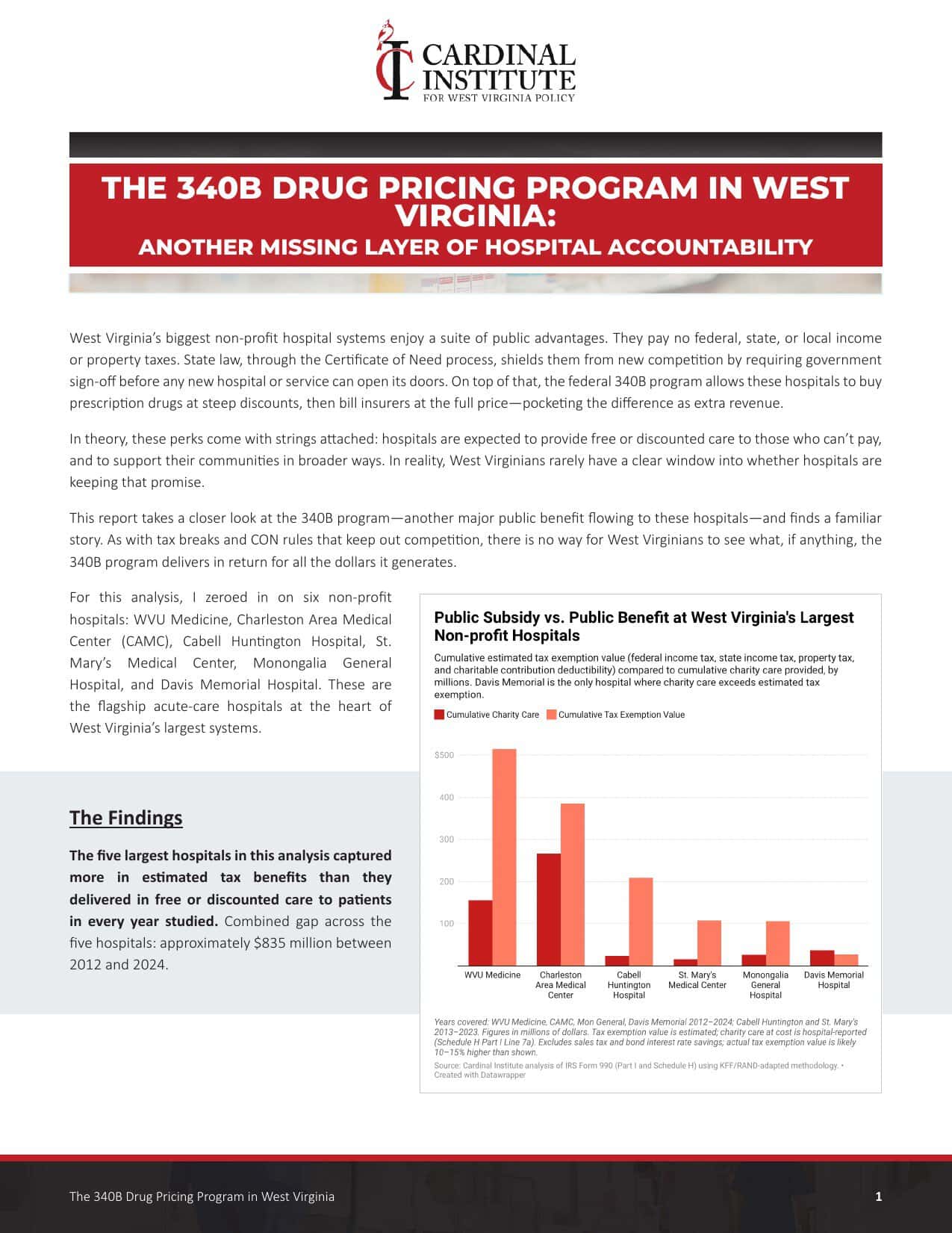
West Virginia’s largest non-profit hospital systems hold three public protections from competition: they pay no income, property, or sales tax; Certificate of Need law blocks new competitors; and the federal 340B program lets them buy drugs at deep discounts and bill insurers at full price. A new Cardinal Institute paper by Jessica Dobrinsky asks a simple question about the third one. What does the public get back, and how would anyone know?
The answer is that no one can know. No federal or state rule requires hospitals to report how much they collect through 340B or how they spend it. What the paper can document is striking. Across the five largest hospitals studied, estimated tax benefits exceeded free or discounted care by roughly $835 million between 2012 and 2024. The only WVU disclosure on record shows $117.3 million in 340B savings at its flagship hospital in a single year against $11.7 million in charity care. And PEIA, which covers more than 200,000 public employees, teachers, and retirees, saw its drug costs jump 24.4% in one year while the rebates that normally offset them grew just 4.4%, with 340B named as a driver.
There is now an opening. In April 2026 a federal appeals court blocked Senate Bill 325, the 2024 law that had barred West Virginia from requiring any 340B reporting. With that bar gone, the state is free to act. The paper lays out what a West Virginia transparency law should require, drawing on the reporting laws Minnesota, Idaho, and Indiana have already passed.