

Op-Ed: Hospitals Collect Tax Breaks. West Virginians Collect Medical Debt.
To many West Virginians, healthcare continues to be a burden more than a lifeline as roughly 180,000 residents, or 13.3% of adults, now facing some sort of medical debt. This is well above the national average of 8.6% and, even worse, nearly one in four of these residents in rural Appalachia have medical debt in collections. Those debts make families more than twice as likely to fall behind on other bills, such as mortgages, car loans, or student debt. This creates a cycle of debt that doesn’t just put a strain on family finances; it also crushes their credit, blocks home-buying power and even keeps them from getting jobs.
As we look for ways to tackle this ever-growing problem, hospitals should be part of the solution. Non-profit hospitals receive enormous tax breaks every year—billions nationally—in exchange for an understanding that they provide “community benefits” like charity care for patients who cannot afford their bills. Charity care can be offered to the uninsured, underinsured, and low-income individuals by reducing or eliminating bills. However, in West Virginia, hospitals seem to be providing little relief for patients despite these benefits. In fact, research from the Cardinal Institute found non-profit hospitals provided less than 1% of net patient revenue on average on charity care during FY 2021-2022. At the same time, these institutions charge commercial payers up to 300% more than Medicare rates.
Additionally, research provided by the Cicero Institute reveals West Virginia ranks last in state-based requirements for non-profit hospital charity care obligations. They state West Virginia has no transparency mandates, no minimum charity spending requirements, and no enforcement mechanisms. Lack of meaningful oversight means non-profit hospitals are empowered to pocket their tax breaks while suing struggling families, garnishing wages, and even seizing bank accounts.
The result is cruelly predictable. Rather than offering financial assistance, major hospital systems have taken patients to court for debts—sometimes during the height of the COVID-19 pandemic. Families who should have qualified for charity care were instead treated like delinquent customers. This is not charity, but such behavior is protected by antiquated laws.
Texas and Illinois are among several states that have enacted policies to address these concerns, tying non-profit hospitals’ tax-exempt status directly to clear charity care requirements. For example, Texas requires non-profit hospitals to spend at least 5% of net patient revenue on community benefit, with a charity care floor of 4%. Those standards are an actionable approach to ensure hospitals actually earn the privileges we, as taxpayers, grant them.
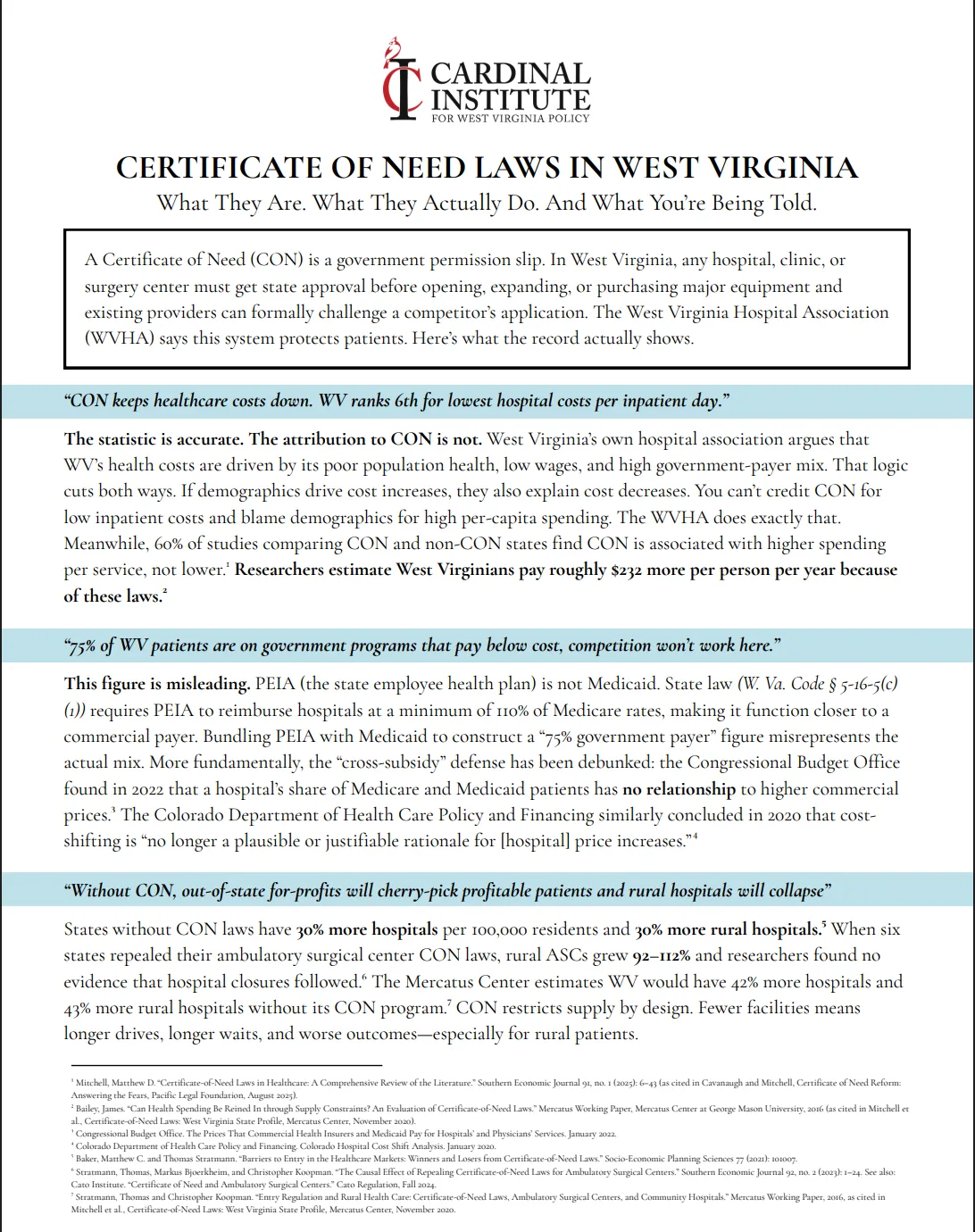
West Virginians deserve the same. Confronting the state’s outdated certificate of need laws is also an important pairing—a legal protection for underperforming and, at times, predatory non-profit hospitals—to ensure real accountability for charity care. Accordingly, non-profit hospitals in West Virginia should be required to publicly report the amount of charity care they provide, set enforcement tied to tax breaks, and ban aggressive collections against patients before they are honestly offered financial assistance.
In a state where one in three residents lives below 200% the federal poverty line, charity care is not simply a policy trade-off for tax-free benefits. Rather, it’s a moral obligation—and a social contract non-profit hospitals entered into with their communities. Tax breaks should be a tool to further means to serve patients, not pad profits. Until our laws reflect that basic principle, West Virginia families will keep paying the price, not in taxes, but in relentless medical debt. West Virginia policymakers should follow the lead of other states by providing much-needed relief to our most vulnerable residents and holding hospitals accountable.
This op-ed was originally published by the Charleston Gazette-Mail.