
West Virginia’s hospital debate is missing a key piece of the financial picture
West Virginia’s hospital debate is missing a key piece of the financial picture
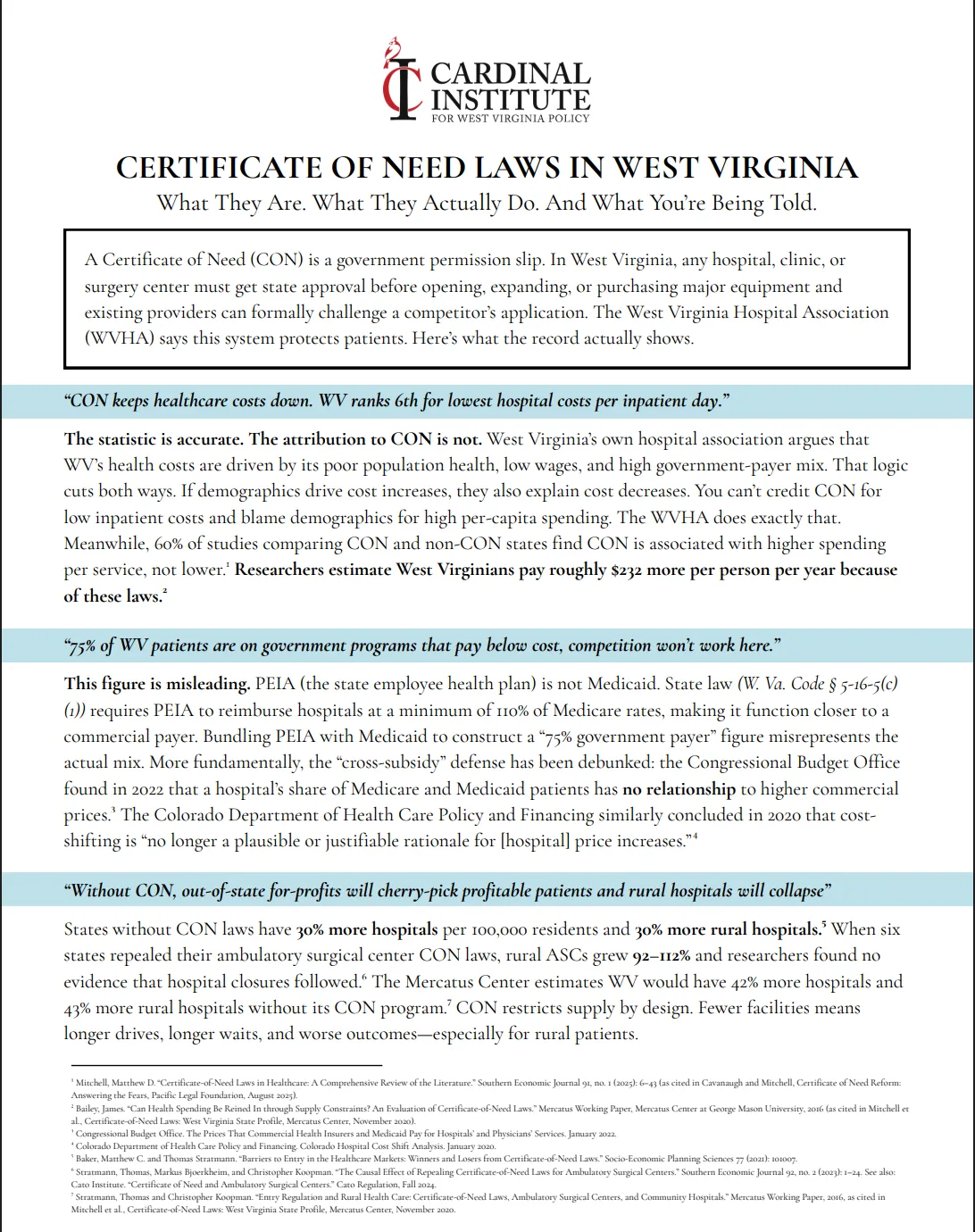
Debates over hospital policy in West Virginia usually follow a familiar pattern. Hospital systems warn that their finances are weak. Industry groups say they have too many patients with government insurance. Certificate of Need (CON) rules are defended as needed to keep hospitals open, especially in rural areas.
What is rarely examined closely is whether the way West Virginia hospitals manage their finances actually supports these claims.
Two recent Cardinal Institute analyses of hospital finance in the state — one focused on charity care and the other on payer mix — suggest the picture is more complicated than the public narrative implies.
Start with payer mix, which is central to nearly every hospital policy argument in West Virginia. Hospitals frequently assert that roughly 75% of their patients are “government payers,” implying that low reimbursement rates leave them financially vulnerable. That figure, however, is constructed by combining Medicare, Medicaid and the Public Employees Insurance Agency (PEIA) into a single category.
That way of grouping matters. PEIA does not work like Medicaid. By West Virginia law, PEIA pays hospitals no less than 110% of Medicare, with no statutory ceiling. In reality, PEIA operates more like commercial insurance than a government safety-net program. When PEIA is counted correctly, the often-quoted “75% government payer” number drops significantly, and the structure of hospital revenue changes.
This does not mean Medicaid or Medicare reimburse generously. It means hospital money in West Virginia is steadier and more publicly supported than crisis rhetoric suggests. Who pays hospitals shows how steady their finances are, not whether every type of insurance brings in extra revenue. That difference is often missed in public debate.
Identifying hospital payers is also important because this information is frequently used to justify CON regulations. Proponents argue that CON protects financially vulnerable hospitals, using payer composition as evidence that increased competition would be detrimental. However, authority over CON and market dynamics primarily resides with large hospital networks rather than small rural facilities. These larger systems, while claiming financial weakness, simultaneously benefit from economies of scale, consolidation, and consistent public program payments.
Charity care adds another dimension to this discussion. Charity care refers to the free or reduced care hospitals provide to patients who cannot afford to pay. It is the mechanism meant to protect patients from medical debt. Using hospital-reported data, charity care at West Virginia non-profit hospitals represents a very small share of net patient revenue — less than 1%.
That fact is often hidden by using larger terms like “uncompensated care,” which conflates charity care with bad debt. But bad debt is not free care. It means bills sent to patients that are canceled only after they do not pay, sometimes after attempts to collect the money. Hospitals have to guess how much of their bad debt came from patients who could have gotten help but did not. Being eligible but not getting help is not a small detail; it is a real problem.
Payer mix and charity care describe two sides of the same system. On one side is the hospital revenue structure: supported by public programs and, in the case of PEIA, reimbursement that resembles commercial payment. On the other side is patient financial exposure: low levels of direct relief and continued reliance on billing and debt.
Rural hospitals are frequently cited in these discussions. Concerns about rural access are valid. But rural hospitals and large health systems deal with fundamentally different limitations. Small facilities contend with limited patient volumes and high fixed costs. Despite this, arguments about payer mix and CON protections are typically made at the system level. Meanwhile, rural hospitals and service lines continue to close under the current regulatory and ownership structures.
These facts accentuate the importance of carefulness in the definitions and classifications that shape policy. When payer mix is cited to justify regulatory protection, how payers are categorized is consequential. Likewise, when non-profit status is defended as a public benefit, the relevant question is how much direct financial protection patients actually receive.
Hospital finance is complex. But complexity should not excuse vague explanations. When non-profit hospitals receive generous tax exemptions, regulatory safeguards, and public subsidies, they should be evaluated on outcome, not narrative — above all, whether patients are protected from medical debt and whether public resources deliver measurable benefits.
This op-ed originally appeared in The Exponenet Telegram